
The Lost Generation: 1,000 Applications, 100 Rejections, Zero Offers
Inside the devastating job hunt destroying Gen Z's mental health—and what we can do about it


It's not every day you meet Esther Perel. And when you do, my advice is simple: listen.
We talked about one of my themes, “The Lost Generation,” for the Forbes CMO Summit—a topic we've been researching since the summer. I started explaining the data: how the most educated generation ever is facing the most hostile job market since the 1980s, how the perfect storm of AI disruption, recession fears, and post-pandemic economic tightening is fundamentally rewiring entry-level work, and how 58% of recent graduates are still searching for full-time employment.
Esther stopped me mid-sentence. "Don't lead with the problem," she said. "Tell me a story. Make me feel it first. Remember, these are our children, not a label."

So let me tell you about Sammie.
The Story Everyone's Missing
Sammie is 22. He felt crushing pressure to perform from the moment he took his high school entry exams. He graduated during the pandemic and spent his freshman year of college on Zoom from his childhood bedroom. Over four years, he debated changing his major five times before finally settling on one major and two minors—desperate to make himself as "relevant to the job market as possible."
He completed three internships. Two were remote. In the third, people barely came to the office.
Sammie couldn't wait to graduate—and was terrified of it. The $78,000 in student loans hanging over him felt like a ticking clock. He didn't just want any job; he wanted a place where he could grow, learn, and actually launch his career.
He started applying months before graduation. Then the rejection emails started arriving. And arriving. And arriving.
To date: Over 1,000 applications submitted. Twenty interviews—most of them video sessions with AI screening tools, not actual humans. One hundred explicit rejections. The rest? Radio silence.
Sammie moved back home. So did most of his friends. They're all looking for work with little success. Some are trying for part-time gigs at bars and restaurants, only to find those positions filled by experienced service workers also struggling in this economy.
Ghosted. Alone. Lost.
Just like: this young woman.

 Tiktok failed to load.
Enable 3rd party cookies or use another browser
But here's what everyone misses: This isn't Sammie's failure. It's ours.
The Data Behind the Desperation
Our latest research reveals the scope of what we're calling "The Lost Generation":
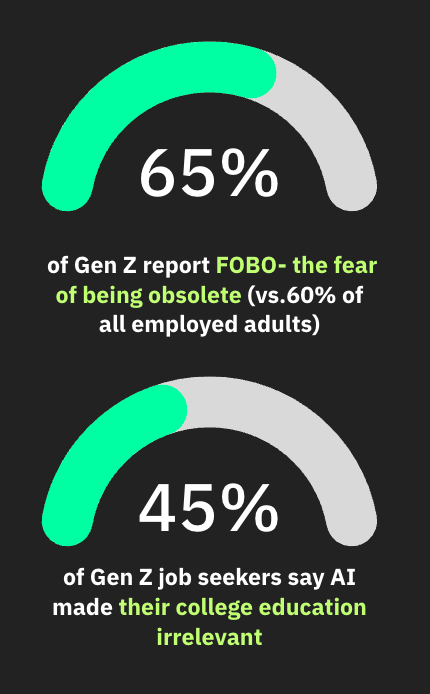
51% view their college degrees as "a waste of money"
58% of recent graduates are still looking for full-time work, compared to just 25% of earlier generations at the same career stage
Young job-hunters are three times less likely to have a job lined up out of school
Our recent poll with Express Employment Professionals showed that 80% of hiring managers anticipate a recession, prompting 83% to cut costs through process streamlining, cross-training, hiring freezes, and layoffs. A perfect storm of forces is systematically eliminating the bottom rung of the career ladder: AI automation, economic uncertainty, pandemic disruption to workplace norms, and aggressive cost-cutting measures. And we haven't reckoned with the implications.
The Cruel Irony
Here's what makes this particularly painful: Gen Z are primary adopters of AI. They navigate AI tools the way elder Millennials knew AOL chat rooms—it's intuitive, native, second nature.
Yet the people benefiting most from workplace AI aren't them. It's those with years of experience who can leverage AI to amplify their expertise, who know how to direct these tools strategically.
Meanwhile, according to Deloitte, 77% of young workers believe AI sets higher expectations for what entry-level employees should achieve, while 63% of executives admit AI will eventually take on mundane tasks currently allocated to entry-level roles.
The economic floor that young people expected beneath them is collapsing in real time.
What Financial Desperation Does to Dreams
This economic reality is forcing impossible choices. Our recent data with Big Brothers Big Sisters of America reveals a generation abandoning passion for survival:
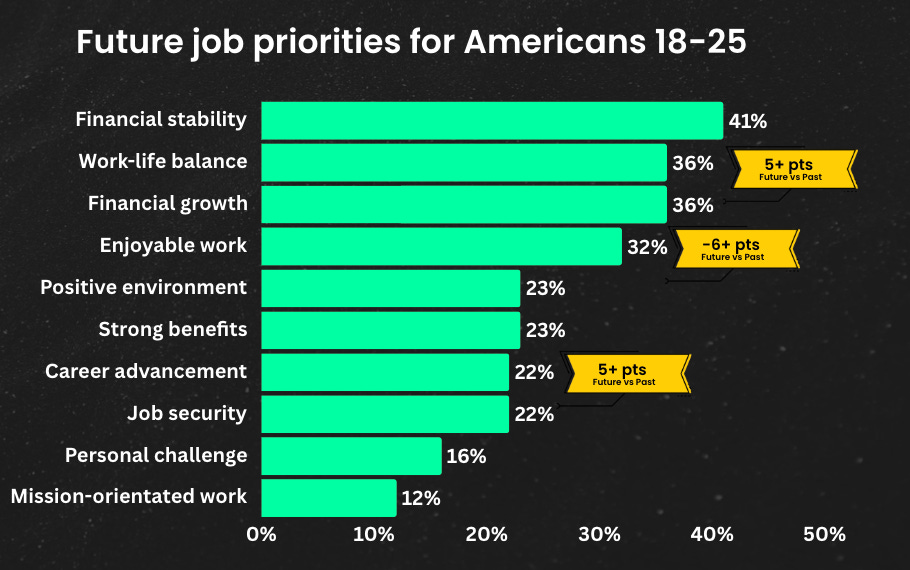
Financial stability is now their top priority (41%) over enjoyable work (32%)
72% of Gen Z say "I would be more excited about AI advancements if there was a financial safety net in place (like universal basic income)"
When you're $78,000 in debt and can't land an interview, you stop thinking about your calling. You think about paying rent.
The Time Bomb No One's Discussing
As Aneesh Raman, Chief Economic Opportunity Officer at LinkedIn, wrote in the New York Times: "We saw what happened in the 1980s when our manufacturing sector steeply declined. Now it is our office workers who are staring down the same kind of technological and economic disruption. Breaking first is the bottom rung of the career ladder."
But here's the question that keeps me up at night: What happens in five to ten years when you need to hire mid-level managers and discover an entire age cohort missing from your talent pool?
What happens when young people feel so stuck they give up entirely—when we see a rise in NEETs (not employed, not in education)?
What happens when we've collectively abandoned our vision for how young people contribute to society and just thrown it back at them to figure out alone?
This isn't a Gen Z problem. These are our children.
What feels most heartbreaking—and utterly broken—to me is this: when young people are lost, we don't take accountability. We're living in a society with a vision deficit, and no one is taking responsibility for it.
It's not on youth to figure this out alone. We need to do better at building these bridges.
Esther was right. This isn't about Gen Z having a massive problem. It's about recognizing these are our children, our nieces and nephews, our neighbors' kids who did everything right, whose parents followed the playbook, and who are now facing a psychological crisis we helped create.
Two Solutions That Actually Work
I don't believe in highlighting problems without offering solutions. Here are two approaches that our research shows can make a real difference:
1. The Power of One Conversation
Our work with Big Brothers Big Sisters reveals something remarkable: you don't need all the answers to help. Even a single conversation can be transformative.
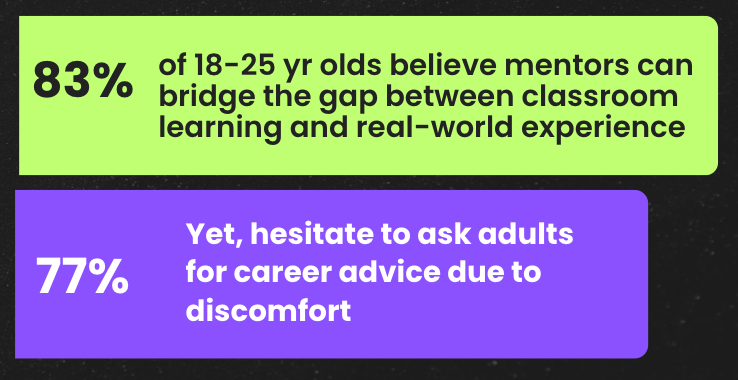
AND——> 65% have had a career-changing conversation with an adult outside their family
84% agree that mentorship helps them see possibilities they might not have considered
One conversation. One connection. That's all it takes to change a young person's trajectory. And we can all do it.
2. Strategic Entry-Level Hiring
Some forward-thinking companies are doing the opposite of pulling back. Elizabeth Buchanan, CCO of Rokt, recently shared that their latest hiring wave focused specifically on entry and junior-level positions. The goal? Bring in fresh perspectives and native understanding of emerging technologies.
A major entertainment company told us they're hiring "as young as possible" for their social media channels—because generational shifts are easier to identify when the people doing the work are from that generation.
This isn't charity. It's strategic. These organizations understand that young hires help them remain agile and understand consumer behavior, especially among younger consumers who have fundamentally different relationships with technology and culture.
Side note: Before anyone argues that hiring entry-level workers is economically naive in an AI-driven world, consider this: The companies thriving right now aren't the ones replacing humans with AI—they're the ones pairing human creativity, adaptability, and cultural fluency with AI tools. Entry-level workers aren't competing with AI; they're learning to leverage it in ways experienced workers often can't. The question isn't whether AI will eliminate these roles, but whether we'll invest in the generation that understands how to work alongside it. That's not charity—that's competitive advantage.
A Call to Action
This is a moment when business leaders need to come together and look beyond the next 18 months. We need a strategic plan to bring more young people into our workforce—not despite the uncertainty, but because of it. Their fresh perspectives and technological fluency aren't nice-to-haves; they're essential to navigating what's next.
And if you're not in a position to hire? Go out of your way to talk to a young person. It doesn't have to be a formal mentorship. Just one conversation, one connection, one piece of advice from your experience.
Because if we leave them hanging, the consequences—for mental health, for social stability, for our collective future—will be dire.
After all, in a world that's fundamentally reshaping work, shouldn't we be investing in the generation that will inherit it?
3 Links
Curiosity is contagious; if you like this newsletter, please share it!!
Penned by Libby Rodney and Abbey Lunney, founders of the Thought Leadership + Futures Group at The Harris Poll.
 | A guest post by
|
Thank you for covering one of the most important issues that not's not being talked about nearly enough. This is absolutely not Gen Z's failure but our failure as a society.
This is a really great piece. Disturbing and important. I appreciate your emphasis on solutions, and it reinforces that the mentoring I'm doing is worthwhile. Thanks.