
The Consent Gap: Why We've Resorted To Public Booing Over AI
Graduates are booing AI off the commencement stage. The real story isn't anger. It's distance.

I can’t stop thinking about the booing.
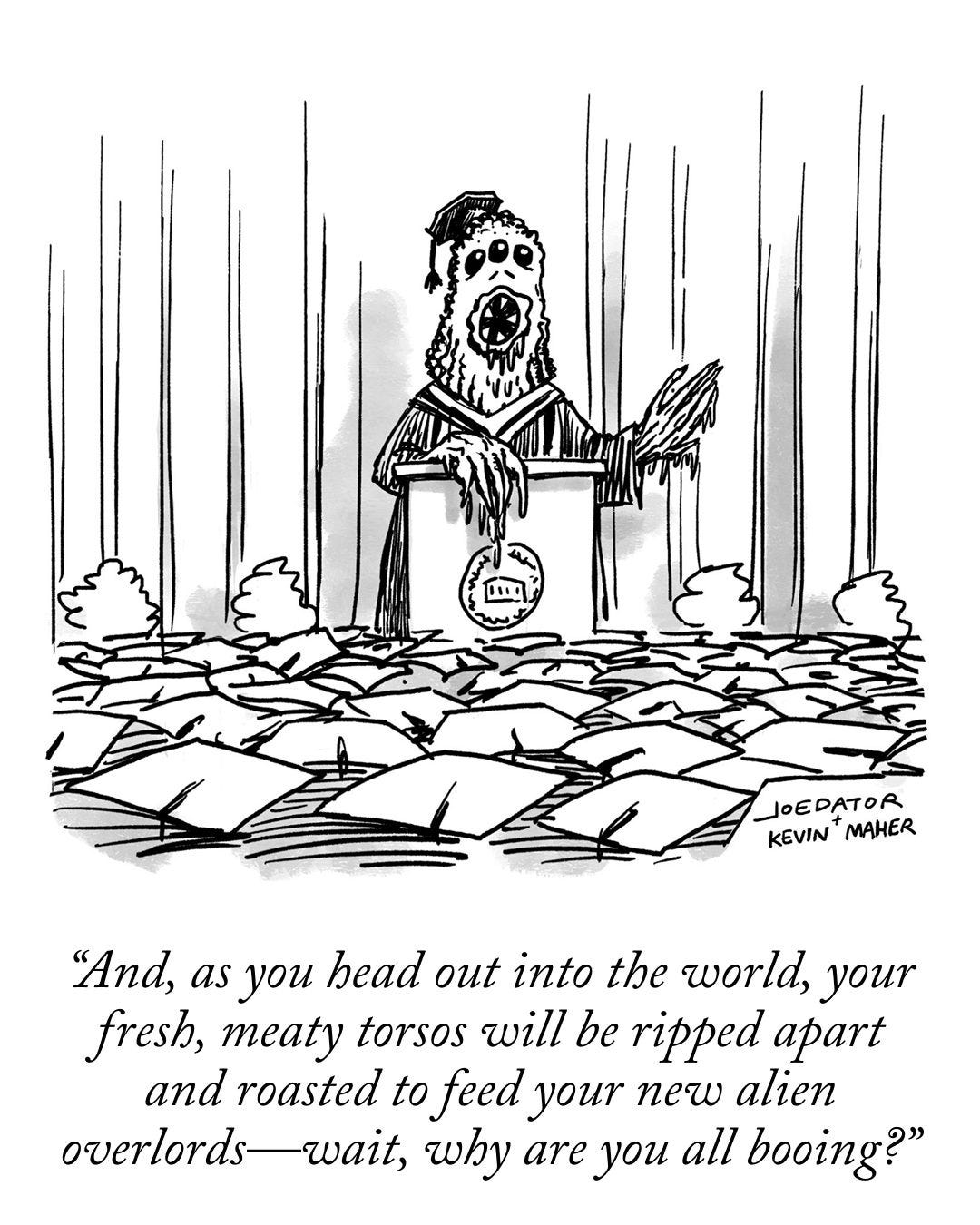
New Yorker Daily Cartoon, by Joe Dator and Kevin Maher.
This commencement season, the stage turned into a battleground. Eric Schmidt got jeered at the University of Arizona after telling graduates that when someone offers you a seat on a rocket ship, you don’t ask which seat. You just get on. At CalArts, the president was booed off stage by art students after cutting creative programs to chase AI partnerships. At Middle Tennessee State, Scott Borchetta, music CEO of Big Machine Learning Group mocked the student hecklers and told them to “deal with it.”
The easy read is that these are uninformed youth luddites throwing a tantrum. But here’s what is actually happening….
We are MILES away from each other on AI. And not just two camps. Everyone is on their own spaceship, running their own narrative.
Tech leaders are on the rocket ship, narrating stories of Ai inevitability.
Government is on its own ship, narrating stories of global dominance and national security; the White House's own words for its new AI oversight order were "cementing America's continued global dominance." The order itself is voluntary, and its review window was negotiated down from 90 days to 30 after the AI companies objected.
The public isn’t on any ship at all. They’re on the ground, picketing data centers. They were never written into anyone's narrative, so they're improvising one out of the only material they have left: refusal.
We’re not having a disagreement about AI. We’re having entirely separate conversations in sealed silos, and the booing is what it sounds like when the silos briefly share the same space.
Underneath all of it is a gap nobody’s naming. Not an information gap, not even an optimism gap. A consent gap. The future is being decided, and almost nobody got asked.
The only people surprised by the booing were the executives, and that surprise is the whole story.
The Distance Gap, Measured
Our research with the Milken Institute put a number on the gap: 41 points.
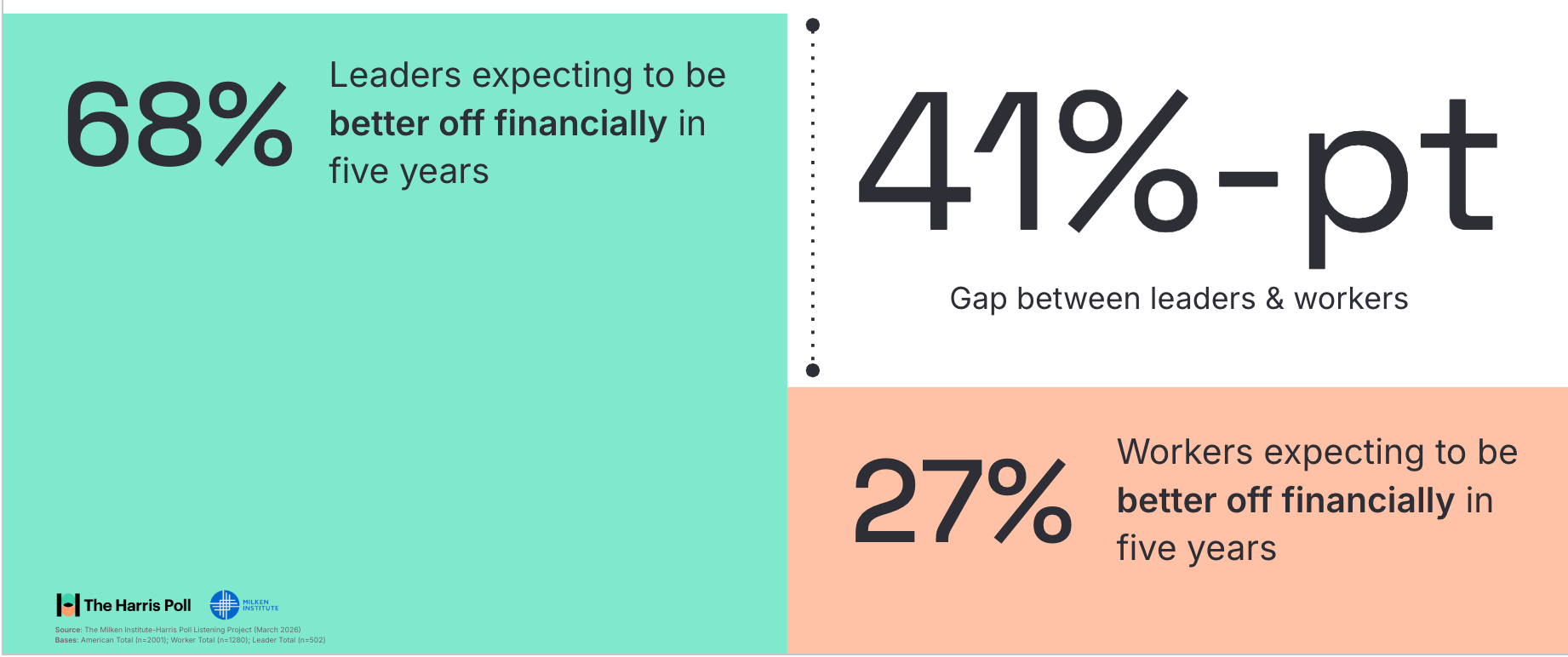
Sixty-eight percent of business leaders expect to be better off financially in five years due to AI. Only 27% of workers do. A 41 point GAP.
Sixty-eight percent of workers say they’re navigating the AI transition entirely alone. No guide, no plan, no conversation with their boss.
This is the vision void I’ve been writing about for six years: the pandemic kicked our linear trajectory out from under us, and nothing has replaced it. A huge share of Americans simply cannot picture what the next ten years look like. When you can’t see the future, you don’t build toward it. You brace for it.
The booing isn’t anti-progress. It’s anti-abandonment. The graduates have heard the pitch and correctly identified the part that gets mumbled: you are negotiable, and we’d rather not discuss it until the new world is built.
You can even watch the void get filled, badly. Seventy percent of Americans now say they’d oppose a data center in their area, and nearly half of proposed projects have been scrapped or delayed (Gallup). As Vox’s Marina Bolotnikova put it this week, Americans don’t know how to fight AI, so they’re fighting the warehouses it lives in. People are so starved for a say in the future that they’re picketing buildings, because nobody handed them a ballot for anything bigger.
Two Paths: Inevitable vs Golden
The frame I keep returning to isn’t original to me. Acemoglu and Johnson argued in Power and Progress that technology’s direction is never inevitable; it’s chosen by whoever holds the power. They wrote it for economists. The students booing Eric Schmidt are making the same argument with their hands.
Notice the difference in how the two paths even speak. The inevitable path has a script, polished and rehearsed in every keynote. The golden path only has questions, because nobody with power has bothered to answer them.
The Inevitable Path says:
The capital argument: AI is efficiency, and efficiency is good for the bottom line. You might lose your job. Maybe new ones come for you. Or not.
The political argument: This is an arms race against China. Either we win, or they set the table.
The momentum argument: Pandora’s box is open. We must open it as fast as possible, regardless.
The CEO argument: I must go AI-first or the next CEO will. Many employees are disposable, and we can’t risk talking about it until the new future is built.
The Golden Path only asks:
What would it look like if this technology made life genuinely better for more people in the next decade? Largely unanswered.
Where’s the new GI Bill for the AI era? We’ve just recently spent $29 billion on the Iran conflict. We find money when something matters. So does this matter?
AI is showing real momentum in medicine, including oncology and drug discovery. What if that became the headline mission instead of the side effect?
Do we need AI everywhere, or only in the places where it makes life more prosperous for more people? Who gets to decide?
Could this be the tool we use to surface more visions of the lives people actually want, and build toward them together?
A script versus a list of open questions. The inevitable path isn’t a law of physics. It’s a story told by people who’d rather you didn’t picture the alternatives, because if you could, you might demand them.
Done To You vs. Built With You
Strip everything down and the difference between the two paths is one word: consent. The inevitable path is done to you. Schmidt’s crime onstage wasn’t optimism, it was telling a room of 22-year-olds not to ask which seat. The golden path is the one where somebody turns to you and says: what do you want to do with this?
That path already exists. When IKEA handed nearly half its customer-service calls to an AI bot, it didn’t fire the people who answered the phones. It retrained 8,500 of them into remote interior-design advisors. Same humans, new role, one they were handed instead of strapped into. That decision built a business that pulled in €1.3 billion in a single year.
Cognizant’s CEO, who oversees 350,000 people, called the layoff predictions “fearmongering” and hired 20,000 entry-level graduates last year. Compare that to the bank boss who described his own employees as “lower value human capital” and spent a week apologizing. Same technology. Opposite relationship to power.
And here’s the thing: people want to be asked. When you actually offer a choice, they take it. Two in three American workers say they would enroll in a government retraining program if AI displaced them.
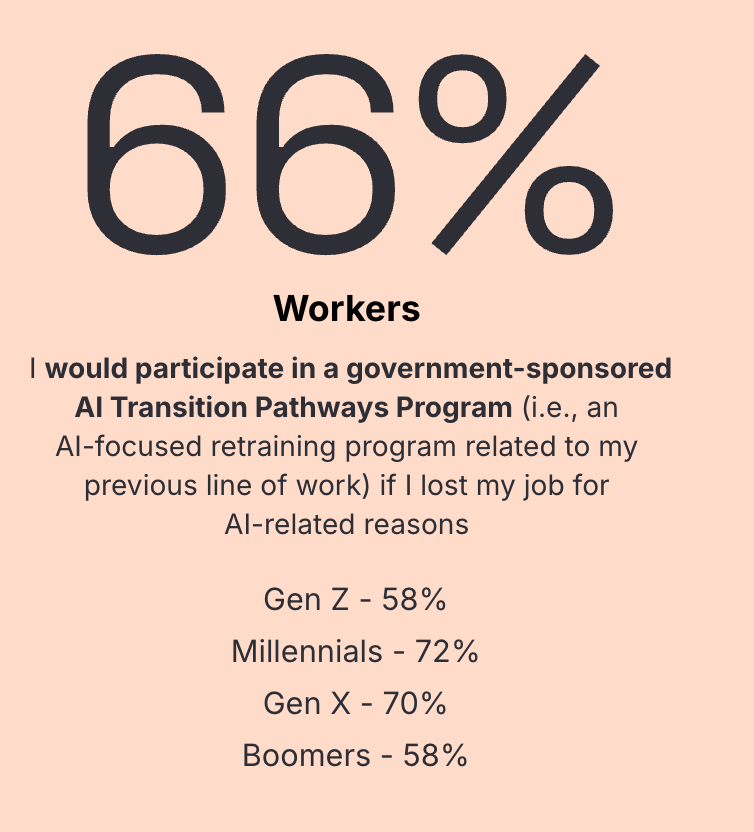
Eighty percent of Americans want the government to start preparing workforce transition programs now. Sixty-nine percent believe AI can create more opportunity than it eliminates. These are not the numbers of a population refusing the future.
Also it’s worth noting, the inevitable path isn’t even as inevitable as advertised. In our research with The Milken Institute we found, 73% of business leaders admitted that if you really looked under the hood, they’re years away from AI having transformative impact inside their organization. And the hood is rattling. Uber capped employee AI spending after blowing through its annual budget in four months. Starbucks scrapped its AI inventory tool across North America after it kept miscounting the milk. Amazon is the latest giant facing the fallout of “tokenmaxxing,” burning compute to look AI-forward. Tech leaders are quietly rationing the very revolution it calls unstoppable. AI with a budget cap isn’t inevitability. It’s a choice, which means a different choice is available.
The Bottom Line
We are miles apart on AI, each group in it’s own silo, running its own narrative, and nobody steering this has offered a future people would actually choose.
So people are filling the void themselves with the only tools they’ve got: booing a billionaire off a stage, blocking data warehouses. That’s not Luddism. That’s what it looks like when people are desperate for a say and keep getting handed a shrug.
This is my obsession, the same one I’ve had for six years: I want to see visions, plural, that people would raise their hand for. Not a rocket ship they didn’t choose. A say.
Here’s my bet. The consent gap is about to become the most expensive line item nobody’s measuring. The leaders who close it will own the next decade of trust, talent, and attachment. The ones who don’t will keep getting booed, and keep being surprised.
The fix starts smaller than you think. Nobody in those audiences was waiting for a perfect plan. They were waiting to be asked. Be the first one onstage who asks.
Curiosity is contagious; if you like this newsletter, please share it!!
Penned by Libby Rodney and Abbey Lunney, founders of the Thought Leadership + Futures Group at The Harris Poll.