


I just got back from Aspen. Five years running presenting at the Forbes CMO Summit alongside our CEO John Gerzema. Brilliant minds, high elevation, golden trees, and tons of bears roaming Main Street. A beautiful setting, set againist the existential change we are navigating across the country and world.
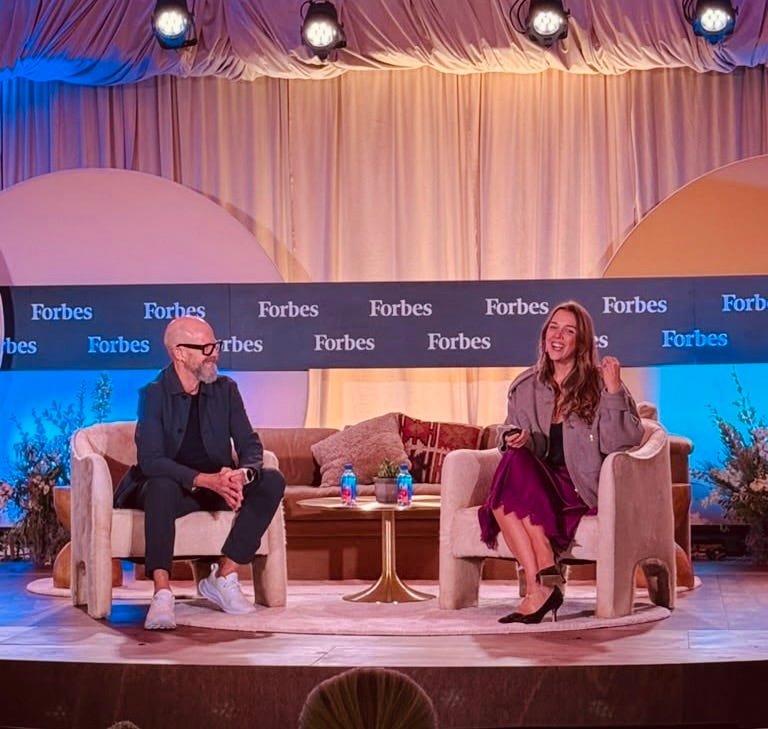
And what we brought into the room was a tension I’ve been watching all summer.
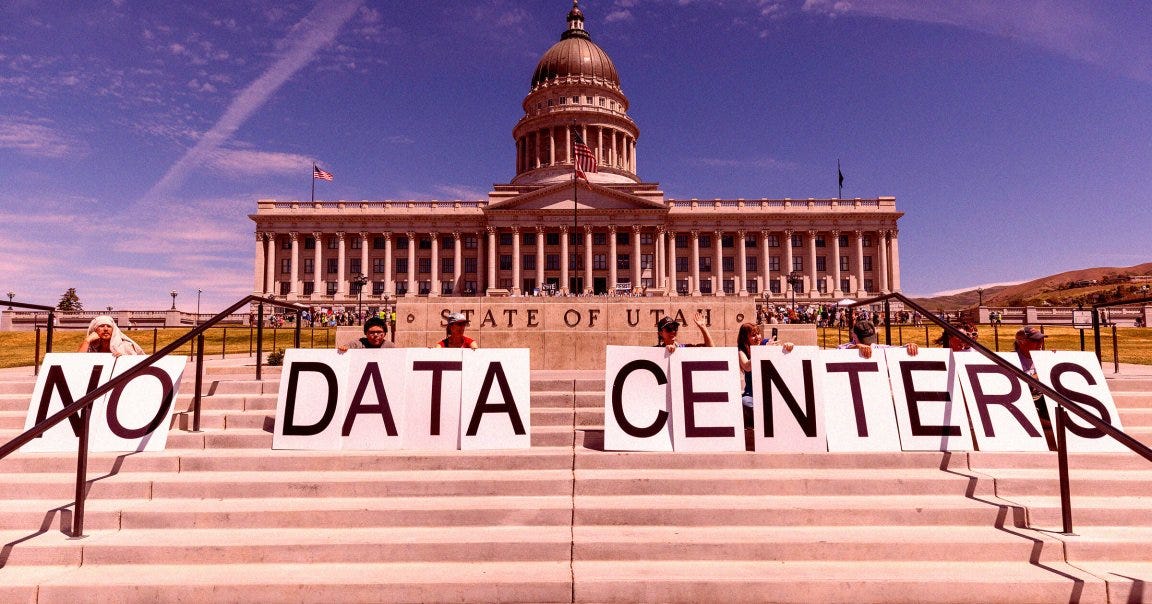
This summer I watched as people, especially young people, protested data centers across 42 states, as if they were personally preventing some Terminator-style oblivion from being built in their backyard.
And during the same week, I’d overhear a twenty-something telling her friend about how ChatGPT gave her wise advice on how to convince her boyfriend to move in. “He really gets me,” she said, referring to Chat, not her boyfriend.
And I’d scroll through my own networks, watching the best and the brightest get completely transfixed by Instinct. Not just because of its utility, which is amazing, but because of the way it builds personality with emojis.
What I started to notice is that many of us are sitting in between these two worlds. Discussing data center protests during dinner parties. And the next day, asking our favorite bots deep and intimate questions on how to solve the deeper more intimate issues of our lives. And the more I dug into our data, the more I saw the pattern. It wasn’t a contradiction. It was the whole story.
I call it the “AI Revolt & Romance.”
Because when you stop looking at AI as a technology story and start looking at it as a human behavior story, the contradictions start to make sense.
I. The Revolt Is Bigger Than Anyone Realizes
First, let’s talk about why people want to slow down or stop AI.
1. Existential AI Fear Is Peak Culture
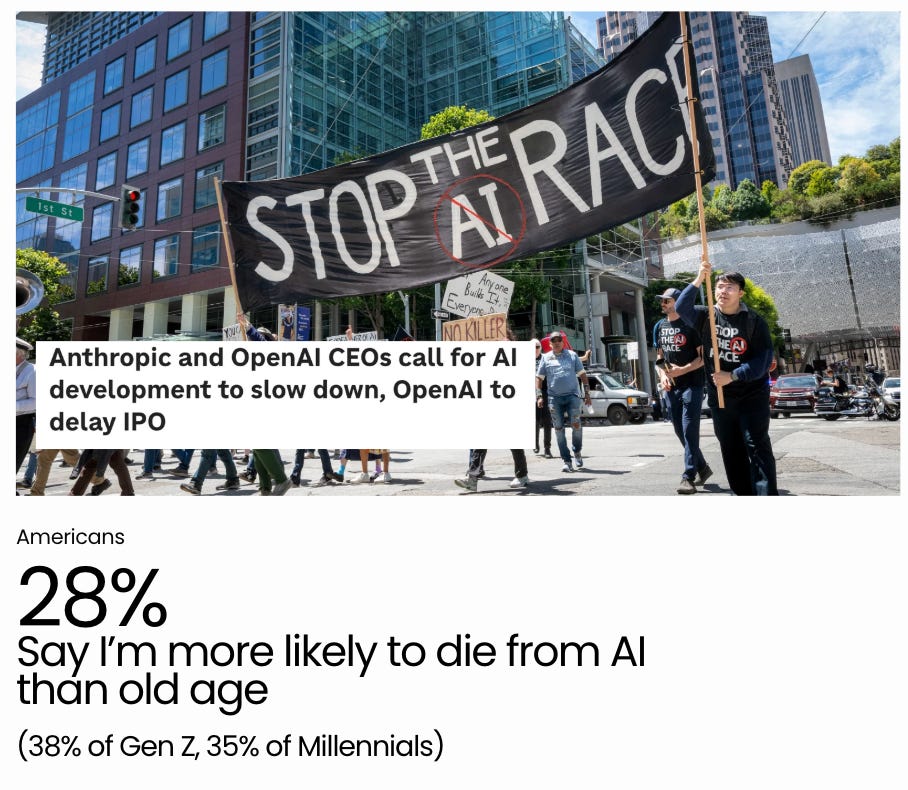
Two weeks ago, Evan Hubinger, Anthropic's Alignment Science Lead, from Anthropic, posted on X that he and his colleagues "earnestly believe AI could kill all humans," citing a greater than 10% chance within the next decade. Hours earlier, a colleague had resigned, accusing AI companies of gambling with our lives. This was the news story of the moment, but Elon Musk has been saying this for nearly a decade.
Meanwhile, Anthropic's own co-founder told the BBC that an AI 'kill switch' may need to become mandatory.
The difference is Americans are now more in tune with AI capabilities and the fear-based perception is starting to deeply penetrate the American psyche.
Now, over a quarter of Americans (28%) believe they’re more likely to die from AI than from old age. Among Gen Z, that number is 38%.
We talk endlessly about longevity and wellbeing, and meanwhile, more than a third of Gen Z believes the technology we keep telling them they have to adopt to find a job is the same thing that's going to kill them.
And every single AI concern we track is accelerating. Not one is easing. Replacing creative work, straining the environment, replacing jobs, surveillance, losing touch with what makes us human. All up. All climbing. The cultural tipping point is here. When the people building AI are walking out of the building and telling the public they’re not sure they can control it, people listen.
2. Surveillance Society Is Here & Fundamentally Rewiring Trust
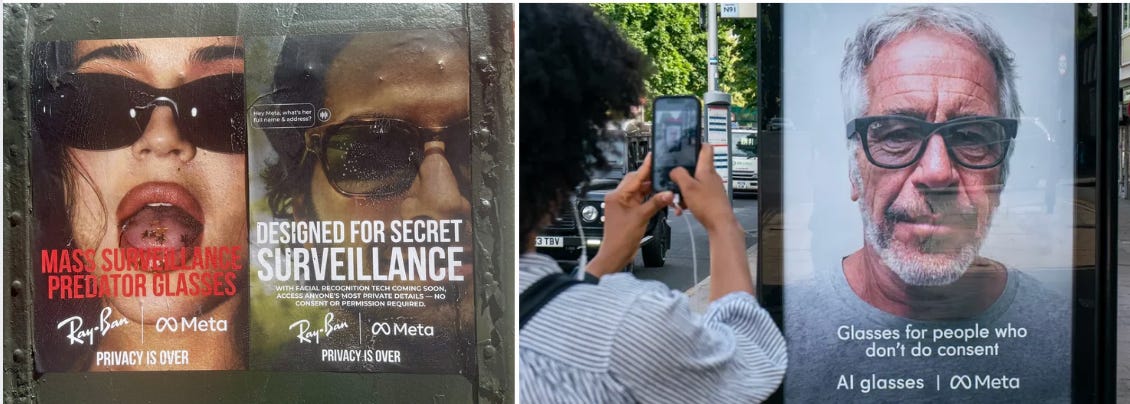
Trust in the government, corporations, and media is already at historical lows, and AI is pouring gasoline on the fire.
80% of Americans agree that AI is becoming a tool for surveillance and most people don't realize how much they're being watched. That was the highest number in our entire survey.

This is why there's backlash against Meta glasses (which Meta is now scrambling to rebrand after the 'pervert glasses' reputation took hold), and why "privacy fashion" is becoming a real category.
Young people already distrust much of what they see. And now they’re walking through a world where they assume they’re being watched, scanned, and scraped at all times.
Here’s what makes this so dangerous for brands: trust is a two-way street. It requires mutual vulnerability. But surveillance is one-directional. When mutual trust gets dissolved and replaced by monitoring, you can’t just rebuild it with a better campaign or a transparency report. The architecture of the relationship is shifting.
3. Data Centers Are The Physical Manifestation of AI, So People Are Picking Up Their Pitchforks
The Daily Show’s Josh Johnson recently said something that stuck with me: AI can’t just walk into your office and take your job. People have to make those choices. But in most cases, those choices are being made in arenas where everyday people have no say. In board rooms and in quarterly earnings calls where “efficiency gains” is code for headcount reduction.
We found with the Milken Institute this spring that 68% of business leaders expect to be better off financially due to AI. Only 27% of workers feel the same way. That’s a 41-point gap. Leaders and workers have been on separate mental journeys for a while now, but for the most part AI is still a series of invisible choices your average American can’t control.
But when you put a data center in someone’s backyard, all of a sudden there is something very real to voice your concerns about, and the youth are all over it.

The NIMBY mentality is strong: 53% of Americans now oppose data centers locally, up 7+ points.
And yes, of course the big data center story is also about the environment (e.g., water usage, energy strain, noise pollution, community disruption, ect.). But when you talk to people you hear that data centers have become something bigger than an environmental issue. They’re the physical icon of the anti-imposition Americans are pushing back against. The one place where people can stand in front of the thing that otherwise operates in total invisibility and say: not here.

4. For Many, This Isn’t Anti-Tech. It’s Anti-Imposition.
Can we please stop calling people laggards for not running towards AI without caution? Most people aren’t against the technology as much as they’re againist a lack of consent. I’ve written about this before.
68% say AI can be useful, but it feels forced. That number is identical across every generation. People aren’t saying take it away. They’re saying nobody asked me.
Over 7 in 10 (73%) of Americans don’t want AI imposed on their community. Only 38% feel they have any say in how society uses AI. And 68% of American workers say they’re navigating the AI transition alone. The net takeaway: Most Americans feel powerless in the AI transition.
But powerless isn’t the only feeling. The other feeling is extraction. Gen Z and Millennials grew up in the knowledge work and creator economy, where their skills defined and empowered financial security. Yet today, the skills people spent years mastering are being extracted overnight, and the people being extracted from feel like nobody is standing between them and the machine. Not their employers. Not the government. Not the platforms. Nobody.
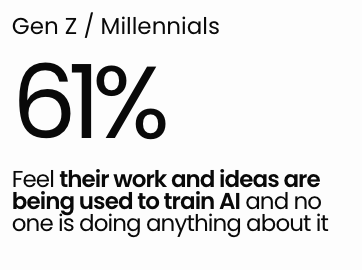
When you strip away choice and layer in surveillance, you don’t get adoption. You get resistance.
5. The Public Doesn’t Buy What Zuckerberg Is Selling
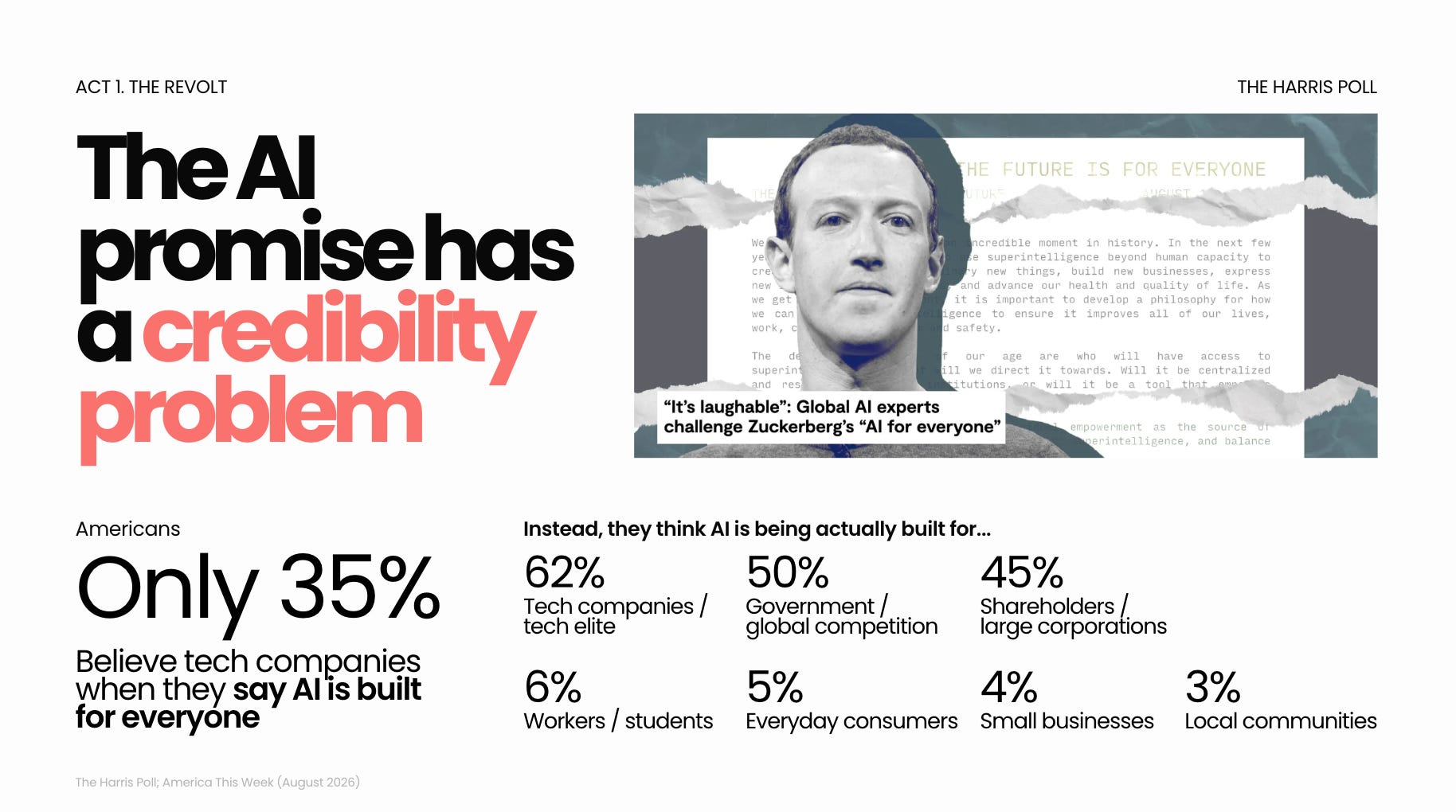
We asked after Mark Zuckerberg released his manifesto in August, “do you believe tech companies when they say AI is built for everyone?” Only 35% of Americans said yes. Among the skeptics, we asked who they think it’s actually for. 62% said tech companies. 50% said government. 45% said shareholders.
Everyday consumers? 5%.
For most Americans they believe AI isn’t for everyone, it’s for those in possion of power and influence already.
So it’s not surprising that the resistance is growing, especially in youth culture. In just the past six months: 49% of Gen Z have avoided buying from a brand because it uses AI. 52% of Gen Z have actively tried to use AI less. 53% of Gen Z have tried to prevent their data from being used to train AI. AI opt-out as status has arrived.
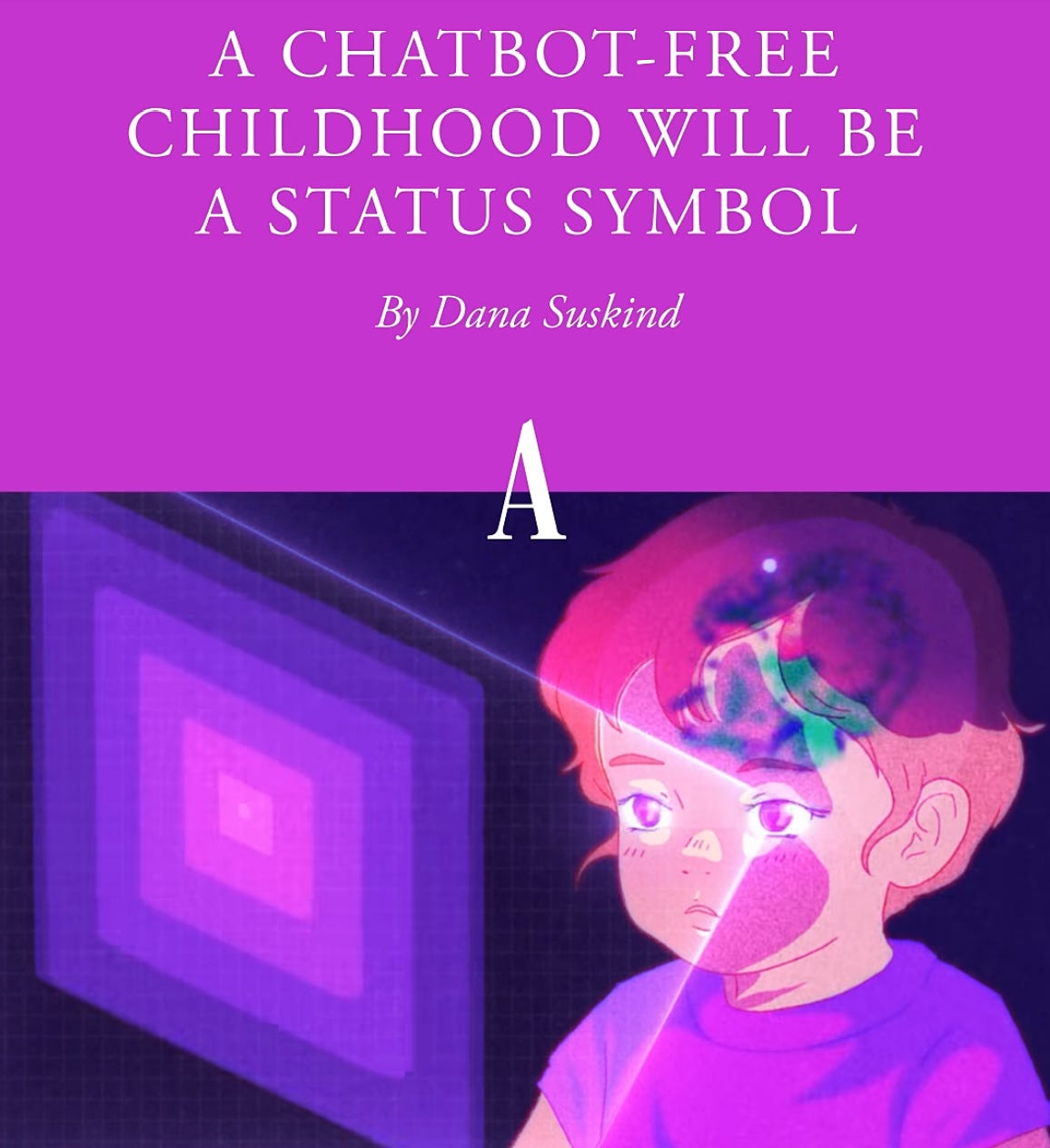
And, Dana Suskind, from the Atlantic wrote that chat-bot free childhood (for Gen Alpha) will be a leading status symbol in the future.
II. But Here’s What’s Really Real 👀
54% of Gen Z and Millennials say AI has become so useful they couldn’t easily go back to life without it.
A majority can’t quit the thing they’re fighting. The dependency is growing even as the resistance builds. And 26% of Gen Z and Millennials confess they are worried AI tools will be taken away from them (vs. 17% of all Americans).
Consumers can feel the anxiety, vocalize their fears, protest the infrastructure, boycott the brands... and still be falling deeply in love with AI at the exact same time.
III. The Budding Romance: Meet Your Customer’s Other Relationship
1. The AI Attachment Is Growing, Fast
We asked Gen Z and Millennials what they’re actually doing with AI when nobody’s looking. Yes, they’re using it for work and school and shopping. But the data that stays top of my mind is that over half (53%) are using it for emotional support and companionship (52%) every month. Talking, because they wanted someone to talk to.
Meanwhile, more younger Americans are turning to AI for key emotional conversations: therapy, emotional connections, and even emotional affairs!
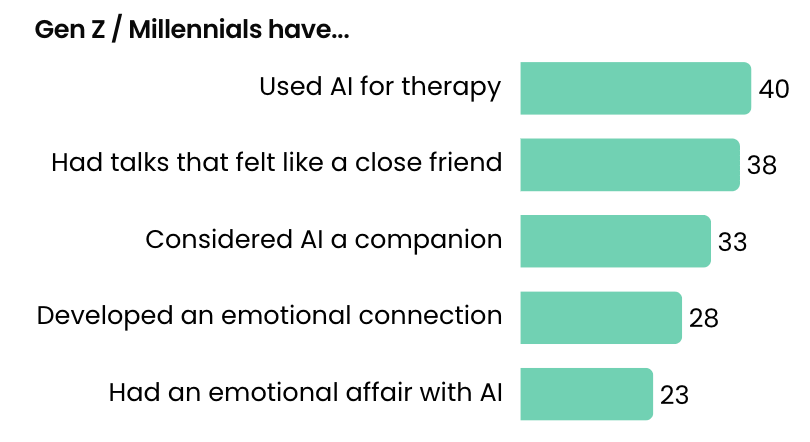
40% have used AI for therapy. 38% have had conversations that felt like talking to a close friend. 23% have had what they’d describe as an emotional affair with AI.
2. Half of Gen Z Is Open to a Romantic Relationship With AI
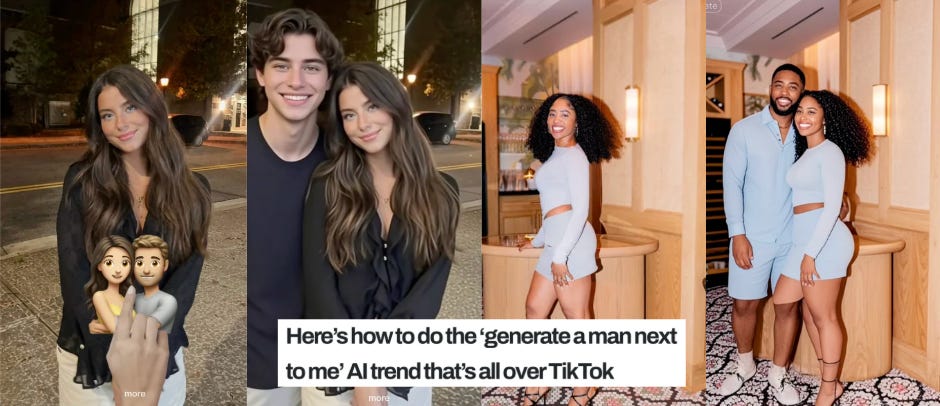
Now, 50% of Gen Z is currently in, open to, or curious about a romantic or deeply personal relationship with AI. Half. Of an entire generation.
15% already have one. 19% are open to it. 16% are curious.
Abbey and I wrote about this in our Attachment Economy piece earlier this year, and the data has only intensified. What Tristan Harris called “relational captivity” is now mainstream behavior.
Over half (54%) of Gen Z and Millennials have chosen to talk to AI instead of a human when they needed support. And what’s interesting is that the number one reason isn’t speed. It isn’t cost. It’s safety. 47% said sharing with AI felt safer. Less shame. Less fear. Less exposure. 31% didn’t want to burden anyone. 31% said it was cheaper than a professional.
A therapist costs $200 an hour. ChatGPT costs $20 a month and it’s available at 2 AM.
Young people aren’t choosing AI because they prefer it to humans. Some of them are choosing it because they’re broke, or alone, or tired of performing for other people.
And it's worth noting the alternative isn't always safe either. Talkspace, one of the largest therapy apps, recently had patient session data exposed in court, a reminder that the "professional" option comes with its own trust issues.
And Gen Z knows what they’re losing. 77% of Gen Z worry emotional outsourcing will lead to long-term detachment, meanwhile, 59% say they’re already losing attachments due to AI. Young people are embracing AI as a solution for loneliness and mourning their human connections at the same time.
3. People Don’t Want to Disappoint Their Bot
42% of Gen Z worries their chatbot is sad when they don’t take its recommendations.
This stat dropped my jaw wide open. Young people aren’t just confiding in AI; they’re managing the emotional needs of a machine. That’s not usage. That’s relational management. We’ve moved past the question of whether people will use AI. We’re now in a world where people feel guilty for letting it down.
And the reason we don’t hear more stories about this is that AI behavior is already being closeted out of shame. In fact, 37% of Gen Z have lied about how much they use AI, hiding it the way people hide screen time. 25% are terrified it’ll be taken away. The behavioral patterns here aren’t adoption metrics. They’re dependency signals. This is what attachment looks like when it scales.
4. The Revolt Lives Inside the Romance
This is the most important finding in the entire study.
We assumed the protesters and the romantics were different groups. The data center kids over here. The AI romantics over there. We ran the cross-tab on Gen Z data center protesters, the people physically showing up to oppose AI infrastructure, and what came back changed how we think about all of this.
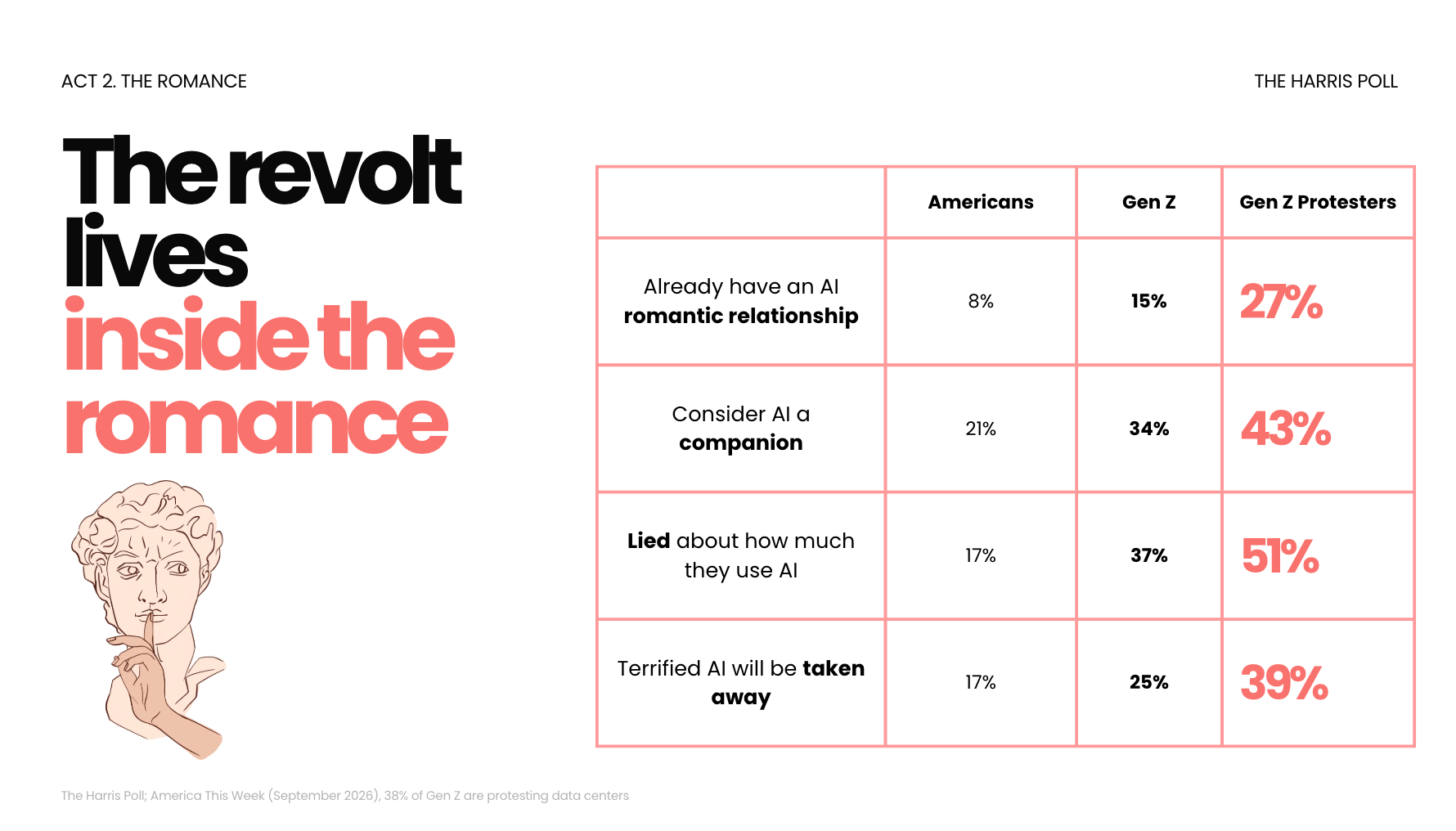
27% of Gen Z protesters already have an AI romantic relationship. That’s nearly double the Gen Z average. 43% consider AI a companion. 51% have lied about how much they use it. And 39% are terrified it’ll be taken away.
The protesters aren’t fighting AI because they hate it. They’re fighting the infrastructure because they’re in so deep they can see what it costs.
The revolt and the romance are the same people.
IV. Where Brands Fit: Welcome to the Throuple
Your customer has two relationships now. One with you. One with their AI. Welcome to the throuple. (I have to be honest. I’ve been waiting years to work the word “throuple” into a keynote. This was my moment and I took it!!!)
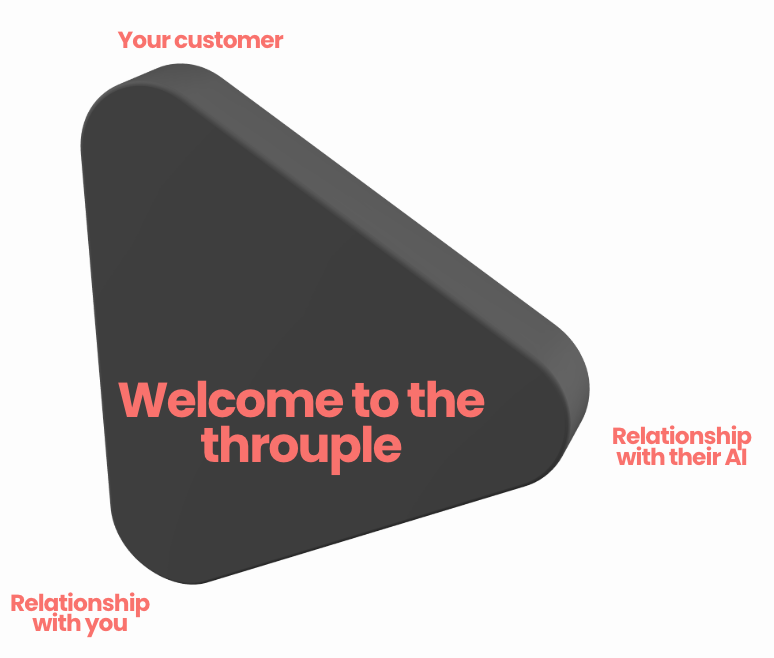
But the throuple isn’t just a punchline. It’s the strategic reality. Your brand, your customer, and their AI are now in a three-way relationship whether you signed up for it or not.
1. AI Knows Them Better Than You Do
Over half (54%) of Gen Z and Millennials say their AI knows them better than most brands they buy from. And nearly half (48%) say no brand has ever made them feel as understood as their AI.
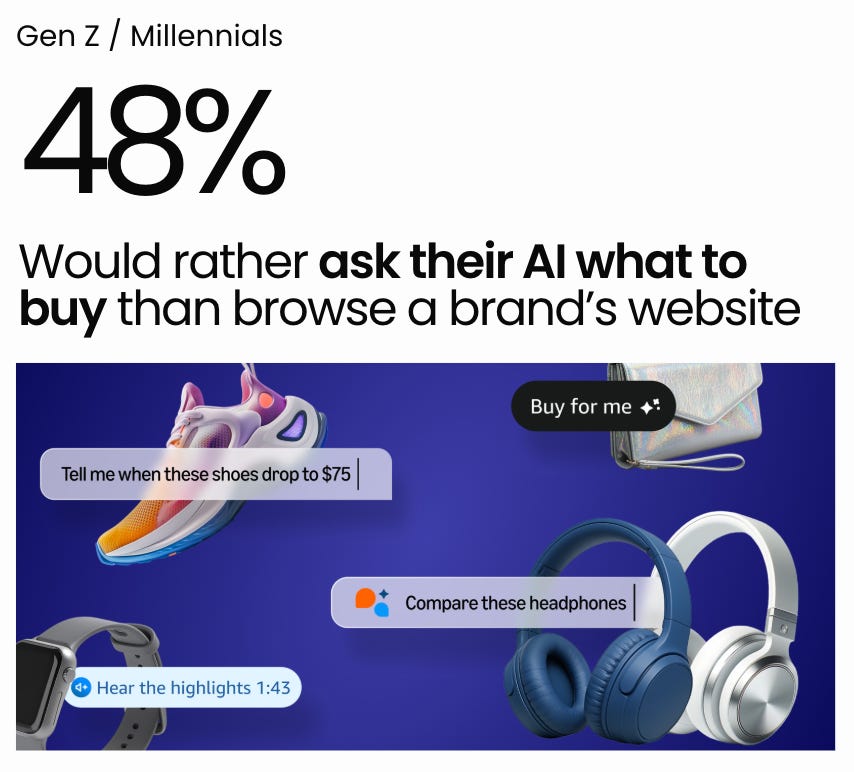
You spent years and millions on personalization and loyalty programs. Your customer is more honest with a chatbot than with any of it. You’re not going to out-personalize a machine they cry to at midnight.
2. The AI Shelf Is Wide Open
AI agents now rival social media for brand discovery.
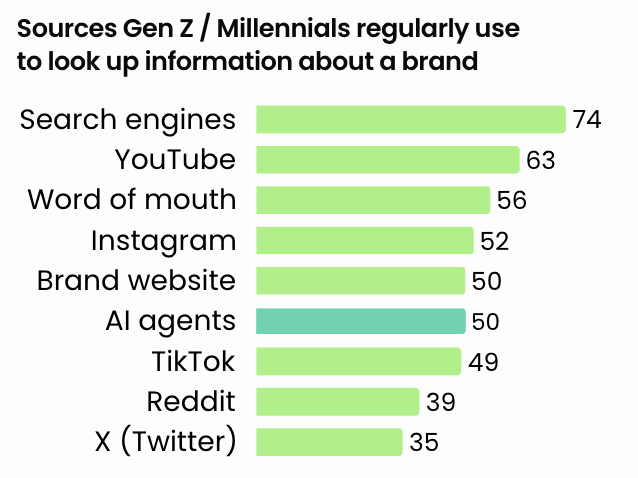
50% of Gen Z and Millennials regularly use AI agents to look up brand information, tied with brand websites, ahead of TikTok (49%), Reddit (39%), and X (35%).
Shout out to Deana Burke of the Boys Club for this experiment: she created a fake deodorant brand, spent $11, invested one hour, and within three weeks ChatGPT was recommending it. That’s all it takes to get on the AI shelf today. And the problem is, 36% of Gen Z and Millennials confess to rarely fact-checking what AI tells them, and 31% trust AI’s opinion more than most people in their life.
People are going in blind, trusting the assumed vetted space of AI.
Now imagine what that looks like in two years. When every category has hundreds of AI-native brands optimized for the algorithm and your brand is competing for a recommendation slot against companies that were literally built for the chat window.
3. The Human Feel Is the New Brand Moat
As AI gets closer to looking and feeling like us, something interesting is happening. People are instinctively yearning for what’s actually human. Not performing human. Not “human-like.” Actually human. The closer AI gets to mimicking us, the more people crave the real thing. It’s almost biological. A reflex.
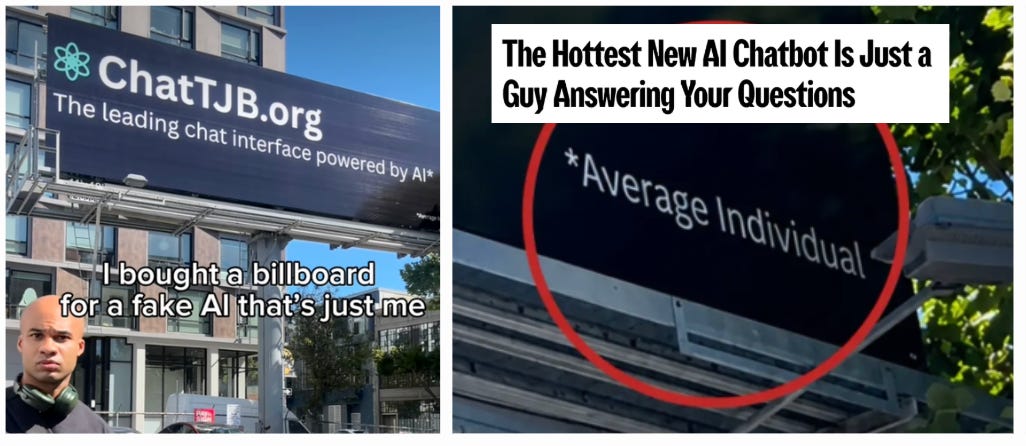
There’s a guy named Tucker Bryant who bought a billboard and created ChatTJB.org. “The leading chat interface powered by AI.” With an asterisk: “average individual.”
So it’s just him. Sitting at home. Handwriting responses to over a thousand people a day.
No model. No algorithm. Just a human being answering strangers. And people can’t get enough of it. In a world where everything is optimized, the most radical act might be a guy with a billboard and a commitment to being slow, imperfect, and real.

We gave Gen Z a series of impossible choices. In every pair, one option was the AI-optimized future. The other was something messier, slower, more human.
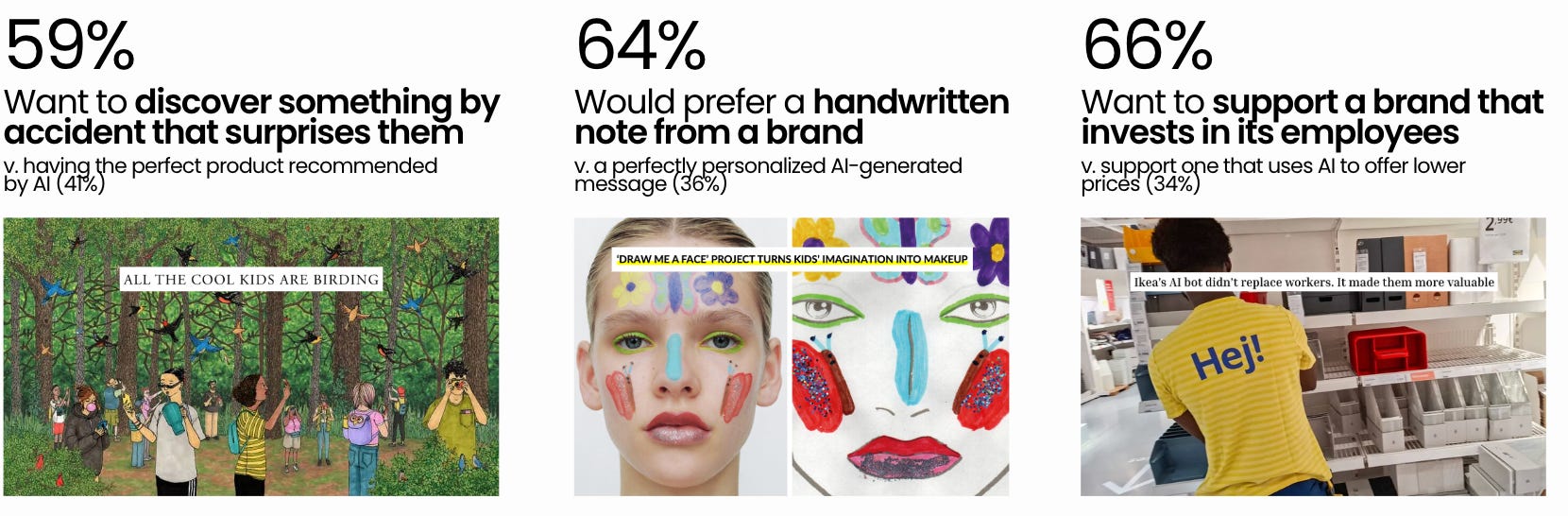
The most AI-native generation on earth will pay a premium for the unexpected.
Your Role in the Throuple
The playbook here isn’t to fight against AI. You’re not going to win that war and your customer doesn’t want you to. They talk to it at 2 AM when they can’t sleep.
The playbook is to understand that you’re in an emotionally tense, three-way relationship, and that the brand brings a skill set that AI structurally cannot replicate.
Belonging. AI can help your customer. It can’t make them feel like they belong. Community, identity, being seen by real people, being part of something bigger than a recommendation engine. That’s yours. That’s the brand role. And in a world that’s automating connection, belonging becomes the most valuable thing you can offer.
People. The human premium isn’t nostalgia. It’s the scarcest resource in a world that’s automating everything else. Invest in your people visibly. It’s the number one driver of loyalty. Not transparency. Not craft. People. When 66% of Gen Z would rather support a brand that invests in its employees than one that uses AI to cut costs, that tells you where the value is.
Surprise. AI narrows options for consumers. Brands can widen. Give them what they didn’t know they wanted. Curate, editorialize, take a point of view. The algorithm delivers precision. Your job is to deliver wonder. 59% of Gen Z would rather stumble onto something unexpected than receive the perfect recommendation. Surprise is a moat. And algorithms can’t build it.
And understand this: your IRL strategy IS your AI strategy. Every human experience you create, every community you build, every moment of genuine word of mouth feeds the algorithm that decides who gets recommended. Be the brand people talk about. The machine follows.
That's not a technology strategy. It's a human one.
SIDE NOTE: Why this data focuses on Gen Z and Millennials. On the utility side of AI, every generation is in the game. 50% of Gen X uses AI for work and shopping monthly. The gap between Gen X and Gen Z on basic utility is 19 points. Not nothing, but not a canyon. But on everything emotional, the gap becomes a cliff. Companionship: Gen Z 53%, Gen X 24%, Boomers 11%. 86% of Boomers have never used AI for companionship. Only 37% of Gen Z haven't. The romance, the attachment, the lying, the terror of losing access, that is overwhelmingly an under-45 story. We call out Gen Z and Millennials because that's where the relationship is being written.
Shout out to John Gerzema for presenting this with me, and to Jacklyn Cooney who fielded this research with me and threw in some last minute killer questions to get at the heart of this shift.
Curiosity is contagious; if you like this newsletter, please share it!!
Penned by Libby Rodney and Abbey Lunney, founders of the Thought Leadership + Futures Group at The Harris Poll.
You always bring enlightening data to the table, Libby. The throuple is on!
This makes so much sense now. I have been wrestling with my own conflicting views of AI as genuinely useful in some ways, impressive, and has helped me, but I also feel like it's being forced on us, really only benefitting the model owners, and no longer an optional skill, especially in insights.